Cult of Sea

Maritime Knowledge base

  • Home
  • Knowledge base
    • Bridge Equipment
    • Cargo Work
    • Deck
    • General
    • Gmdss
    • Maritime Law
    • Marpol
    • MLC 2006
    • Meteorology
    • Navigation
    • Safety
    • Security
    • Ship Construction
    • Ship Handling
    • Ship Stability
    • Shippie’s Escape
    • Surveys
    • Tankers
  • Colreg’s (ROR)
    • Index (Colreg’s)
    • Part A- General
      • Rule 1 – Application
      • Rule 2 – Responsibility
      • Rule 3 – General Definitions
    • Part B- Steering and Sailing
      • Section 1 (Rule 4 -10)
        • Rule 4 – Application
        • Rule 5 – Lookout
        • Rule 6 – Safe Speed
        • Rule 7 – Risk of collision
        • Rule 8 – Action to avoid collision
        • Rule 9 – Narrow Channels
        • Rule 10 – Traffic separation schemes
      • Section 2 (Rule 11 – 18)
        • Rule 11 – Application
        • Rule 12 – Sailing vessels
        • Rule13 – Overtaking
        • Rule 14 – Head on situation
        • Rule 15 – Crossing situation
        • Rule 16 – Action by give-way vessel
        • Rule 17 – Action by stand-on vessel
        • Rule 18 – Responsibilities between vessels
      • Section 3 (Rule 19)
        • Rule 19 – Conduct of vessels in restricted visibility
    • Part C- Lights and Shapes
      • Rule 20 – Application
      • Rule 21- Definitions
      • Rule 22 – Visibility of lights
      • Rule 23 – Power-driven vessels underway
      • Rule 24 – Towing and pushing
      • Rule 25 – Sailing vessels underway and vessels under oars
      • Rule 26 – Fishing vessels
      • Rule 27 – Vessels N.U.C or R.A.M
      • Rule 28 – Vessels constrained by their draught
      • Rule 29 – Pilot vessels
      • Rule 30 – Anchored vessels and vessels aground
      • Rule 31 – Seaplanes
    • Part D- Sound and Light Signals
      • Rule 32 – Definitions
      • Rule 33 – Equipment for sound signals
      • Rule 34 – Manoeuvring and warning signals
      • Rule 35 – Sound signals in restricted visibility
      • Rule 36 : Signals to attract attention
      • Rule 37 – Distress signals
    • Part E- Exemptions (Rule 38)
      • Rule 38 – Exemptions
    • Part F – Verification of compliance with the provisions of the Convention
      • Rule 39 – Definitions
      • Rule 40 – Application
      • Rule 41 – Verification of compliance
    • Annexes
      • Annex 1 – Positioning and technical details of lights and shapes
      • ANNEX II – Additional Signals for Fishing Vessels Fishing in Close Proximity
      • ANNEX III – Technical Details of Sound Signal Appliances
      • ANNEX IV – Distress Signals
  • Glossary
  • Contact

Cargo Calculations – Tanker Work

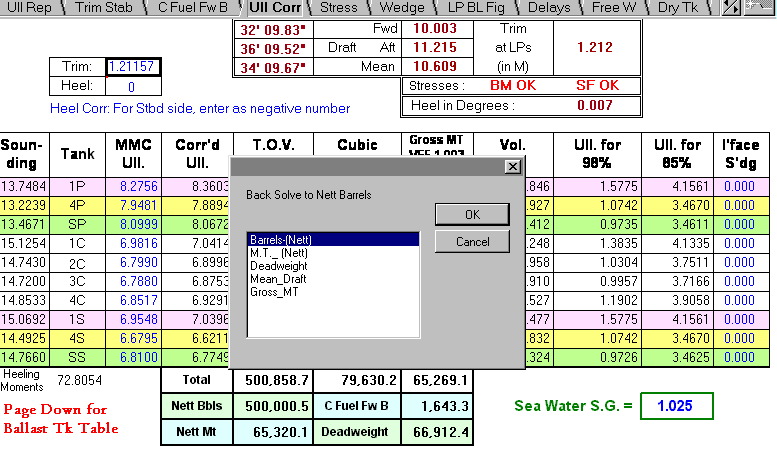
General An oil volume can only be measured at its prevailing temperature and it, therefore, follows that the standard volume must usually be calculated. Unfortunately, different countries have different standard (reference) temperatures.Generally, the reference temperatures are:In Eastern Bloc, Brazil 20oC; In Western Europe 15oC; In the USA 60oF. The situation is further confused in that there are primarily two volumetric units, which are:In metric countries the cubic meter (m ) In non-metric countries the barrel (Bbl).Combining a statement of volume … [Read more...]

By Cult of Sea Filed Under: Tankers Tagged With: 15degree, 60degree, air, api, astm, cargo, crude, density, gross weight, gsv, mass, obq, rob, sg, specific gravity, stasco, tankers, vacumn, weight

mariner-gps
Sail Time
Simple Colregs COS Ad

Join Our List

Subscribe to our mailing list and get interesting stuff and updates to your email inbox.

Powered with ♥ by Cult of Sea

instagram-button

What others are reading

Pi-club

Protection & Indemnity Clubs

GMDSS Batteries Requirements

International Institutions and their Association with Shipping (ILO, WHO, ISF, ICS, BIMCO, SIGTTO, OCIMF)

Using Magnetic compass in Polar Regions

General Average York Antwerp Rules

What is General Average & the importance of York-Antwerp Rules ?

Part B - Section 2

Rule 15 – Crossing situation

The Pivot Point

Anchoring - Ship movement

Anchoring – An Effective means of Controlling Ship’s Movement

Gas Tanker Types

Gas Tanker – Types, Tanks, Reliquefaction & Cargo handling opertions

ISM Code

ISM Code – All you should know about International Safety Management Code

Lifebuoy

Lifebuoys

Special Areas under MARPOL

Employment Agreement

Seafarers employment agreements – MLC 2006

Types of Combination Carriers

What is Load on Top (LOT)?


About Us | Terms | Contact Us | Sitemap | Marine Glossary (BETA)

Cult of Sea®™ · Made with ❤ by a small band of sailors