Cult of Sea

Maritime Knowledge base

  • Home
  • Knowledge base
    • Bridge Equipment
    • Cargo Work
    • Deck
    • General
    • Gmdss
    • Maritime Law
    • Marpol
    • MLC 2006
    • Meteorology
    • Navigation
    • Safety
    • Security
    • Ship Construction
    • Ship Handling
    • Ship Stability
    • Shippie’s Escape
    • Surveys
    • Tankers
  • Colreg’s (ROR)
    • Index (Colreg’s)
    • Part A- General
      • Rule 1 – Application
      • Rule 2 – Responsibility
      • Rule 3 – General Definitions
    • Part B- Steering and Sailing
      • Section 1 (Rule 4 -10)
        • Rule 4 – Application
        • Rule 5 – Lookout
        • Rule 6 – Safe Speed
        • Rule 7 – Risk of collision
        • Rule 8 – Action to avoid collision
        • Rule 9 – Narrow Channels
        • Rule 10 – Traffic separation schemes
      • Section 2 (Rule 11 – 18)
        • Rule 11 – Application
        • Rule 12 – Sailing vessels
        • Rule13 – Overtaking
        • Rule 14 – Head on situation
        • Rule 15 – Crossing situation
        • Rule 16 – Action by give-way vessel
        • Rule 17 – Action by stand-on vessel
        • Rule 18 – Responsibilities between vessels
      • Section 3 (Rule 19)
        • Rule 19 – Conduct of vessels in restricted visibility
    • Part C- Lights and Shapes
      • Rule 20 – Application
      • Rule 21- Definitions
      • Rule 22 – Visibility of lights
      • Rule 23 – Power-driven vessels underway
      • Rule 24 – Towing and pushing
      • Rule 25 – Sailing vessels underway and vessels under oars
      • Rule 26 – Fishing vessels
      • Rule 27 – Vessels N.U.C or R.A.M
      • Rule 28 – Vessels constrained by their draught
      • Rule 29 – Pilot vessels
      • Rule 30 – Anchored vessels and vessels aground
      • Rule 31 – Seaplanes
    • Part D- Sound and Light Signals
      • Rule 32 – Definitions
      • Rule 33 – Equipment for sound signals
      • Rule 34 – Manoeuvring and warning signals
      • Rule 35 – Sound signals in restricted visibility
      • Rule 36 : Signals to attract attention
      • Rule 37 – Distress signals
    • Part E- Exemptions (Rule 38)
      • Rule 38 – Exemptions
    • Part F – Verification of compliance with the provisions of the Convention
      • Rule 39 – Definitions
      • Rule 40 – Application
      • Rule 41 – Verification of compliance
    • Annexes
      • Annex 1 – Positioning and technical details of lights and shapes
      • ANNEX II – Additional Signals for Fishing Vessels Fishing in Close Proximity
      • ANNEX III – Technical Details of Sound Signal Appliances
      • ANNEX IV – Distress Signals
  • Glossary
  • Contact

Pump Types / Characteristics – Tanker Basics

Pumps

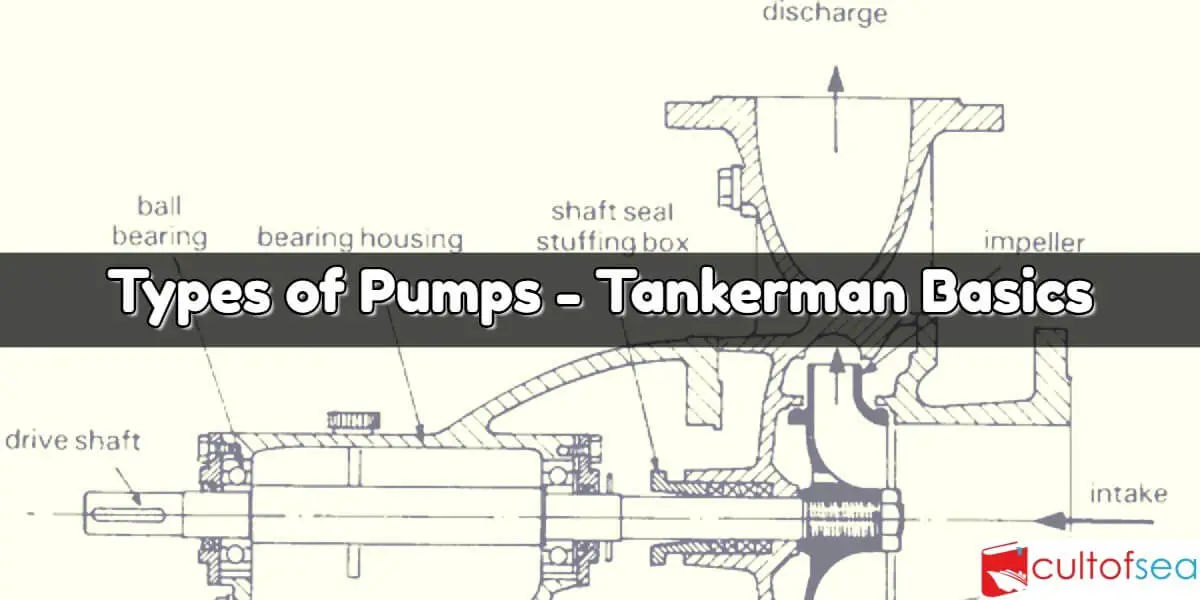
There are many types of pumps, each with its own characteristics, advantages and disadvantages. Basically, pumps can be broadly categorised into 3 types :Non-positive-displacement pumps e.g. centrifugal pumps Positive displacement pumps e.g. reciprocating pumps, gear pumps, screw pumps, etc. Special devices like eductors which can also be included in this category.Centrifugal Pumps This type of pump does not have a self-priming capability. Consequently, it operates best only when there is a positive head on the suction side. However, this pump has the distinct capability of … [Read more...]

By Capt. Angad S Cheema Filed Under: Tankers Tagged With: Bernoulli, centrifugal, eductor, gear pump, oil tanker, pumps, reciprocating, screw pump, tankers, vacstrip

mariner-gps
Sail Time
Simple Colregs COS Ad

Join Our List

Subscribe to our mailing list and get interesting stuff and updates to your email inbox.

Powered with ♥ by Cult of Sea

instagram-button

What others are reading

Blu code

BLU Code – Code Of Practice For The Safe Loading And Unloading Of Bulk Carriers

Piping Arrangement – Conventional Oil Tanker Basics

Part D - Sound and Light Signals

Rule 36 : Signals to attract attention

The Procedure For Transferring The Registry

Hot work on ships

Hot Work – Definition, Responsibility, Process and Risks On-board Ships

alarp risk

What is ALARP and why do you need to know it?

Ship's magnetic compass

Ship’s Magnetic Compass – Dry and Wet Compass with their care, maintenance and bubble removal

Guidelines on Working aloft or Overside on Ships

Molasses – Carriage on Tankers

Part D - Sound and Light Signals

Rule 33 – Equipment for sound signals

Part B - Section 1

Rule 6 – Safe Speed

Annex

Annex I – Positioning and technical details of lights and shapes

Types of Combination Carriers

Part B - Section 2

Rule 12 – Sailing vessels

Portable Fire Extinguishers


About Us | Terms | Contact Us | Sitemap | Marine Glossary (BETA)

Cult of Sea®™ · Made with ❤ by a small band of sailors