Cult of Sea

Maritime Knowledge base

  • Home
  • Knowledge base
    • Bridge Equipment
    • Cargo Work
    • Deck
    • General
    • Gmdss
    • Maritime Law
    • Marpol
    • MLC 2006
    • Meteorology
    • Navigation
    • Safety
    • Security
    • Ship Construction
    • Ship Handling
    • Ship Stability
    • Shippie’s Escape
    • Surveys
    • Tankers
  • Colreg’s (ROR)
    • Index (Colreg’s)
    • Part A- General
      • Rule 1 – Application
      • Rule 2 – Responsibility
      • Rule 3 – General Definitions
    • Part B- Steering and Sailing
      • Section 1 (Rule 4 -10)
        • Rule 4 – Application
        • Rule 5 – Lookout
        • Rule 6 – Safe Speed
        • Rule 7 – Risk of collision
        • Rule 8 – Action to avoid collision
        • Rule 9 – Narrow Channels
        • Rule 10 – Traffic separation schemes
      • Section 2 (Rule 11 – 18)
        • Rule 11 – Application
        • Rule 12 – Sailing vessels
        • Rule13 – Overtaking
        • Rule 14 – Head on situation
        • Rule 15 – Crossing situation
        • Rule 16 – Action by give-way vessel
        • Rule 17 – Action by stand-on vessel
        • Rule 18 – Responsibilities between vessels
      • Section 3 (Rule 19)
        • Rule 19 – Conduct of vessels in restricted visibility
    • Part C- Lights and Shapes
      • Rule 20 – Application
      • Rule 21- Definitions
      • Rule 22 – Visibility of lights
      • Rule 23 – Power-driven vessels underway
      • Rule 24 – Towing and pushing
      • Rule 25 – Sailing vessels underway and vessels under oars
      • Rule 26 – Fishing vessels
      • Rule 27 – Vessels N.U.C or R.A.M
      • Rule 28 – Vessels constrained by their draught
      • Rule 29 – Pilot vessels
      • Rule 30 – Anchored vessels and vessels aground
      • Rule 31 – Seaplanes
    • Part D- Sound and Light Signals
      • Rule 32 – Definitions
      • Rule 33 – Equipment for sound signals
      • Rule 34 – Manoeuvring and warning signals
      • Rule 35 – Sound signals in restricted visibility
      • Rule 36 : Signals to attract attention
      • Rule 37 – Distress signals
    • Part E- Exemptions (Rule 38)
      • Rule 38 – Exemptions
    • Part F – Verification of compliance with the provisions of the Convention
      • Rule 39 – Definitions
      • Rule 40 – Application
      • Rule 41 – Verification of compliance
    • Annexes
      • Annex 1 – Positioning and technical details of lights and shapes
      • ANNEX II – Additional Signals for Fishing Vessels Fishing in Close Proximity
      • ANNEX III – Technical Details of Sound Signal Appliances
      • ANNEX IV – Distress Signals
  • Glossary
  • Contact
You are here: Home / Tankers / FLAMMABILITY COMPOSITION DIAGRAM
Flammability

FLAMMABILITY COMPOSITION DIAGRAM

Flammability Diagram

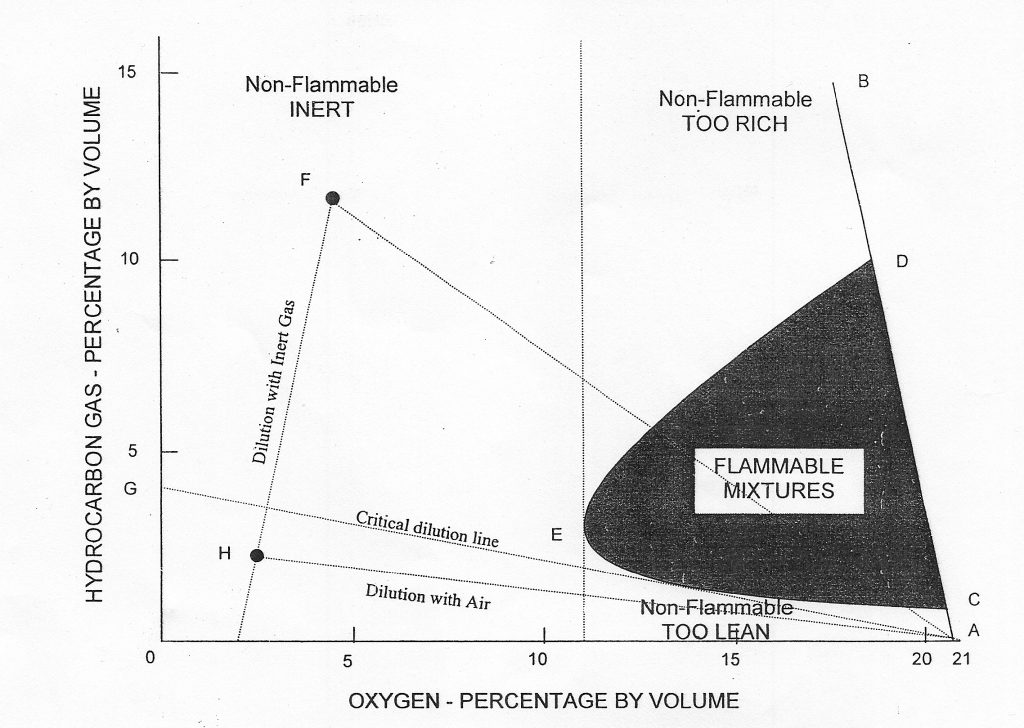
The diagram given above (Flammability Composition Diagram) can be considered the most important diagram to understand the concept of flammability.

Hydrocarbon gas normally encountered in petroleum tankers cannot burn in an atmosphere containing less than approximately 11% oxygen by volume. Accordingly, one way to provide protection against fire or explosion in the vapour space of cargo tanks is to keep the oxygen level below that figure.

The flammable limits vary for different pure hydrocarbon gases and for mixtures derived from different liquids. For practical purposes, the lower and upper flammable limits of crude oil vapours are taken to be 1% and 10% respectively by volume. These values are indicated by points C and D on the line AB in the figure.

Any point in the diagram represents mixtures of hydrocarbon gas, air and inert gas, specified in terms of hydrocarbon gas and oxygen contents. As inert gas is added to the hydrocarbon gas/air mixture, the flammable range decreases until a point, represented by E, is reached where LFL and UFL coincide. This point corresponds to an oxygen content of approximately 11%. For practical purposes and to allow a safety margin, 8% is taken as the level of oxygen at which no hydrocarbon gas/air mixture can burn under any circumstances.

To prevent fire or explosion in the tank containing hydrocarbon gas/air mixture, it is, therefore, necessary to produce and supply inert gas having an oxygen content not normally exceeding 5% and to displace the existing air in the tank until the resultant oxygen level throughout the tank does not exceed by 8% by volume.

Related:

  • Inert Gas on board Tankers - All you need to know!
  • Gas Tanker - Types, Tanks, Reliquefaction & Cargo…
  • Tanker Terminology used in Shipping
  • Cargo Calculations - Tanker Work
  • Gas Tanker Basics - Definitions and Hazards
  • Condition Assessment Scheme (CAS)

By Capt. Angad S Cheema Filed Under: Tankers Tagged With: flammability, flammable range, hydrocarbon, inertgas, lfl, tanker, ufl

Comments

  1. Jomer Udtohan says

    August 4, 2021 at 12:08 pm

    Very informative. Thank you

    Reply

Leave a Reply Cancel reply

Your email address will not be published. Required fields are marked *

mariner-gps
Sail Time
Simple Colregs COS Ad

Join Our List

Subscribe to our mailing list and get interesting stuff and updates to your email inbox.

Powered with ♥ by Cult of Sea

instagram-button

What others are reading

Edible oil

Recommended Practices for Storage and Transport of Edible Oils and Fats

Harmonized System of Survey and Certification

Harmonized System of Survey and Certification (HSSC)

Ballast Water Exchange

Ballast Water Management – Merchant Ships

Part B - Section 1

Rule 10 – Traffic separation schemes

Principles of Ship Handling

Ship's Waterplane, Block, Midship and Prismatic Coefficient

Coefficients of Form – Ship’s Waterplane, Block, Midship and Prismatic Coefficient

Molasses – Carriage on Tankers

Inert gas

Inert Gas on board Tankers – All you need to know!

Part B - Section 1

Rule 5 – Lookout

Solar System

Solar system and Kepler’s law of Planetary Motion

Note of Protest vs Letter of Protest

Note of Protest vs Letter of Protest – Why, When and Differences between NOP & LOP

Lifting Operation

Lifting Operations Onboard Ship

The Procedure For Transferring The Registry

SART

What is SART – Search and Rescue Radar Transponder?

Double Hull

Types of Double Hull Tankers


About Us | Terms | Contact Us | Sitemap | Marine Glossary (BETA)

Cult of Sea®™ · Made with ❤ by a small band of sailors