Cult of Sea

Maritime Knowledge base

  • Home
  • Knowledge base
    • Bridge Equipment
    • Cargo Work
    • Deck
    • General
    • Gmdss
    • Maritime Law
    • Marpol
    • MLC 2006
    • Meteorology
    • Navigation
    • Safety
    • Security
    • Ship Construction
    • Ship Handling
    • Ship Stability
    • Shippie’s Escape
    • Surveys
    • Tankers
  • Colreg’s (ROR)
    • Index (Colreg’s)
    • Part A- General
      • Rule 1 – Application
      • Rule 2 – Responsibility
      • Rule 3 – General Definitions
    • Part B- Steering and Sailing
      • Section 1 (Rule 4 -10)
        • Rule 4 – Application
        • Rule 5 – Lookout
        • Rule 6 – Safe Speed
        • Rule 7 – Risk of collision
        • Rule 8 – Action to avoid collision
        • Rule 9 – Narrow Channels
        • Rule 10 – Traffic separation schemes
      • Section 2 (Rule 11 – 18)
        • Rule 11 – Application
        • Rule 12 – Sailing vessels
        • Rule13 – Overtaking
        • Rule 14 – Head on situation
        • Rule 15 – Crossing situation
        • Rule 16 – Action by give-way vessel
        • Rule 17 – Action by stand-on vessel
        • Rule 18 – Responsibilities between vessels
      • Section 3 (Rule 19)
        • Rule 19 – Conduct of vessels in restricted visibility
    • Part C- Lights and Shapes
      • Rule 20 – Application
      • Rule 21- Definitions
      • Rule 22 – Visibility of lights
      • Rule 23 – Power-driven vessels underway
      • Rule 24 – Towing and pushing
      • Rule 25 – Sailing vessels underway and vessels under oars
      • Rule 26 – Fishing vessels
      • Rule 27 – Vessels N.U.C or R.A.M
      • Rule 28 – Vessels constrained by their draught
      • Rule 29 – Pilot vessels
      • Rule 30 – Anchored vessels and vessels aground
      • Rule 31 – Seaplanes
    • Part D- Sound and Light Signals
      • Rule 32 – Definitions
      • Rule 33 – Equipment for sound signals
      • Rule 34 – Manoeuvring and warning signals
      • Rule 35 – Sound signals in restricted visibility
      • Rule 36 : Signals to attract attention
      • Rule 37 – Distress signals
    • Part E- Exemptions (Rule 38)
      • Rule 38 – Exemptions
    • Part F – Verification of compliance with the provisions of the Convention
      • Rule 39 – Definitions
      • Rule 40 – Application
      • Rule 41 – Verification of compliance
    • Annexes
      • Annex 1 – Positioning and technical details of lights and shapes
      • ANNEX II – Additional Signals for Fishing Vessels Fishing in Close Proximity
      • ANNEX III – Technical Details of Sound Signal Appliances
      • ANNEX IV – Distress Signals
  • Glossary
  • Contact

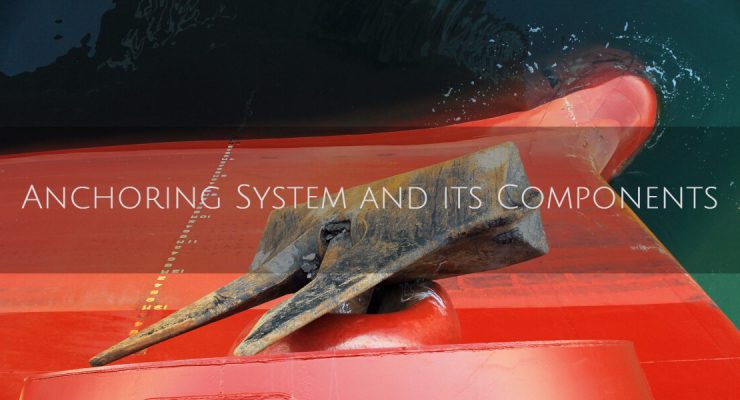
Anchoring System and its Components On-board Ships

Anchoring System and Components

The anchoring system is intended for safely mooring a vessel lying offshore in reasonable weather conditions. The system must be capable of keeping the vessel in position as per the holding power of anchor determined through the calculation of 'Equipment Number'. It is of paramount importance that the system is specified, designed, installed, operated and maintained in accordance with manufacturer's instructions, Class requirements and the owner's needs.The holding power of the anchor determined from its EN (Equipment Number) will not be sufficient to maintain the position of the ship in … [Read more...]

By Capt. Angad S Cheema Filed Under: Deck Tagged With: anchor, chain stopper, hawse pipe, spurling pipe, stockless, winch, windlass

Anchor Terminology used in Shipping

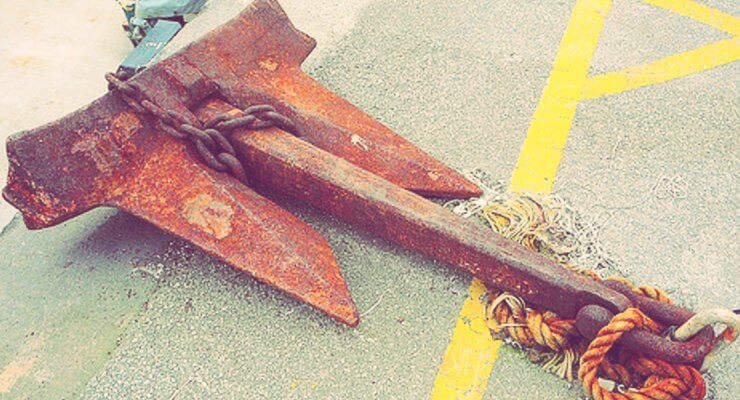
Ship Anchor

Anchor ‘a’ cock bill: When the anchor is hanging vertically from the hawse pipe with the flukes turned into the ship’s side, it has been just clear of the hawse pipe and its weight is taken by the brake in readiness for letting go. In this position, it is not stowed correctly in the hawse pipe. Anchor coming home: When the anchor is being drawn towards the ship in the operation of heaving away, by means of the windlass, the anchor is said to be anchor coming home. Anchor aweigh: The anchor is said to be aweigh immediately it is clear of the bottom. Anchor dragging: The anchor is said … [Read more...]

By Capt. Angad S Cheema Filed Under: Deck Tagged With: anchor, aweigh, bonnet, brought up, clear, cockbill, deck, drag, foul, grow anchor, guillotine, gypsy, hang, hawse, long stay, ship anchor, short stay, snub, spurling, terms, veer, watping, windlass, yawning

mariner-gps
Sail Time
Simple Colregs COS Ad

Join Our List

Subscribe to our mailing list and get interesting stuff and updates to your email inbox.

Powered with ♥ by Cult of Sea

instagram-button

What others are reading

Rule 19 – Conduct of vessels in restricted visibility

Part B - Section 1

Rule 7 – Risk of collision

Flammability

FLAMMABILITY COMPOSITION DIAGRAM

Documentary-Credit-System-Shipping-Icons8

Documentary Credit System in Shipping – Basics Explained with Flowchart

Part B - Section 2

Rule 12 – Sailing vessels

vts

Vessel Traffic Service (VTS) – Purpose, Organisation and its components

Surface Preparation Standards

Harmonized System of Survey and Certification

Harmonized System of Survey and Certification (HSSC)

Ship's magnetic compass

Ship’s Magnetic Compass – Dry and Wet Compass with their care, maintenance and bubble removal

Gas Tanker - Hazards & Definitions

Gas Tanker Basics – Definitions and Hazards

Rising and Setting of Celestial Bodies

Toggle Pin

Using Toggle Pin

The Inclining Experiment

The Inclining Experiment – Ascertain the GM of Vessel

Part B - Section 1

Rule 10 – Traffic separation schemes

Hatch Covers Cover

Hatch Covers – Function, Inspection, Tests, Precautions, Operation, Maintenance


About Us | Terms | Contact Us | Sitemap | Marine Glossary (BETA)

Cult of Sea®™ · Made with ❤ by a small band of sailors